Too Many Projects? A Weekly Reset for Work, Side Jobs, and Big Ideas
Create one project map, limit active work, resolve competing deadlines, and use AI to plan a week you can actually complete.
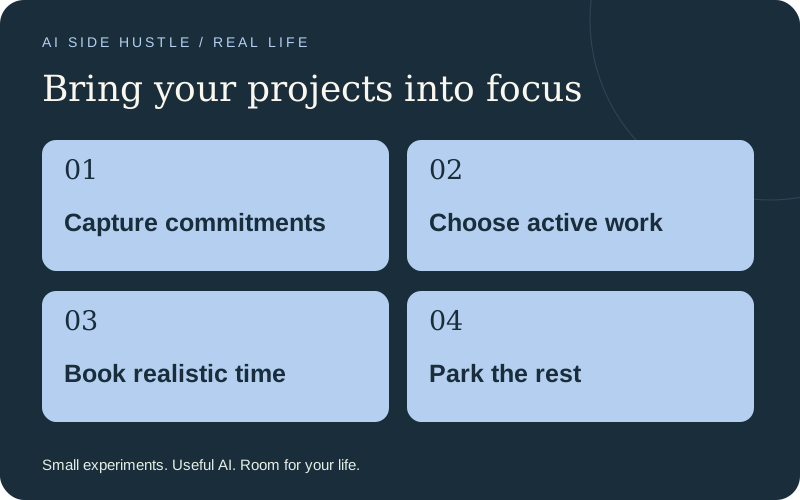
Managing many projects is often a problem of competing promises. A list with fifty tasks does not tell you which project should receive your limited attention. Give each project a visible status and keep the active list small enough to finish meaningful work.
Make one project map
Use a sheet or notebook with six columns: project, outcome, next action, owner, due date, and status. Start with paid commitments and essential work. Add new ideas last. Keep sensitive customer details out of a general AI planning prompt.
| Status | Meaning | Example |
|---|---|---|
| Active | Receives a work block this week. | Finish one client draft by Thursday. |
| Waiting | Needs a specific input from someone else. | Customer must approve photos; follow up on Tuesday. |
| Parked | A deliberate pause with a review date. | Review the new template idea on December 7. |
| Finished / closed | Delivered, handed over, or intentionally stopped. | Pilot complete; record what was learned. |
A 30-minute weekly reset
- Capture for five minutes
Collect commitments from your calendar, notes, and messages. Write outcomes rather than vague project names: “deliver the approved checklist,” not “marketing.”
- Choose for ten minutes
Protect existing deadlines first. As a starting limit, choose one income experiment plus necessary client delivery. A new active project requires deciding what moves out.
- Schedule for ten minutes
Give the next action a realistic block, including setup and review. Reserve some unassigned capacity for interruptions instead of planning every minute.
- Close for five minutes
Write the next action for each active project, who is waiting on whom, and the date of your next review. End planning when the time is up.
Separate your roles
- In your day job: honor working hours, confidentiality, and obligations. Keep side-hustle work and files separate unless your employer has agreed otherwise.
- For side work: state response times and delivery dates. Two small clients can still create conflicting urgent requests.
- For personal projects: decide which ones are recreation and which ones are commercial experiments. A hobby does not have to earn its place by making money.
Fictional example: Jordan has a client video due Thursday, a new printable idea, and a website redesign. The video stays active. The printable gets one 30-minute customer conversation. The redesign is parked until next month. That is a deliberate capacity decision, not a failure to pursue a vision.
Use AI as a planning assistant
Try this AI prompt
Group these tasks by project: [nonsensitive list]. Available time: [hours]. Fixed deadlines: [dates]. Identify dependencies and conflicts. Propose one essential outcome and at most two supporting tasks. Put other ideas in a parking list with review dates. Do not schedule over family commitments or change any external calendar.
A calendar automation can remind you to review the map; it cannot decide which promise matters without your judgment. Keep a manual next-action note so a missed reminder does not stop the whole system. If your realistic workload still exceeds capacity, renegotiate or remove work instead of making the schedule denser.
Download the free experiment planner, or shape your offer. Browse the complete real-life guide collection.