Juggle Family and a Side Hustle With a Plan Everyone Can See
Agree work windows, care handoffs, shared calendar rules, and a fallback for the weeks that do not go to plan.
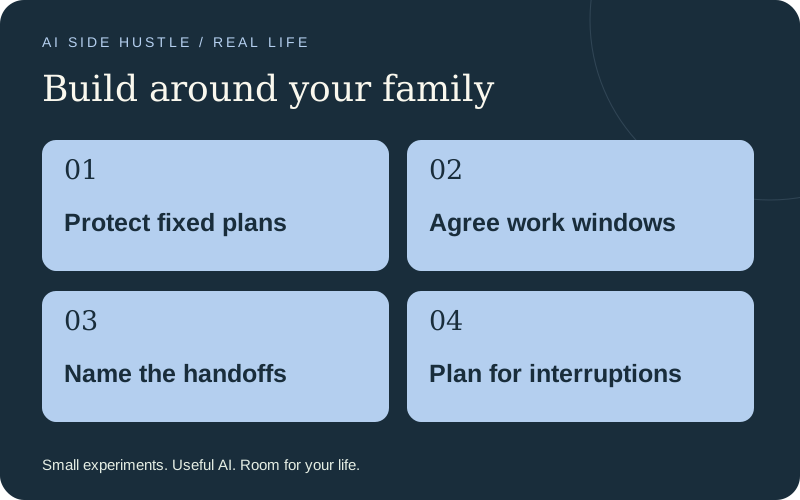
A side hustle should fit the people and responsibilities in your life. The useful question is not “Where can I squeeze in more work?” It is “What can our household realistically support this week?” Make the agreement together instead of assuming everyone else will absorb the extra load.
Hold a 15-minute household planning conversation
- Share the fixed commitments
List work, school, appointments, care responsibilities, transport, and family plans. Ask each adult what time they need protected too.
- Agree on two work windows
Pick short, reliable blocks with a clear start and end. Name who owns any caregiving or household task during each block; shared visibility alone is not shared responsibility.
- Name the disruption plan
Decide what happens if a child is ill, work runs late, or a helper is unavailable. Move or shrink the side-hustle task; do not assume someone else can cover.
- Review without blame
At the end of the week, discuss what was useful and what felt unfair. Adjust hours, scope, or support before increasing commitments.
An example week with three hours available
| Block | Purpose | What to protect |
|---|---|---|
| Tuesday · 45 minutes | One customer conversation and notes. | A mutually agreed care handoff; no surprise extension. |
| Thursday · 75 minutes | Create or finish one small deliverable. | A realistic end time and a saved next-action note. |
| Weekend · 30 minutes | Review the result and plan one next step. | Choose a time that works for the household rather than automatically taking family time. |
| Unassigned · 30 minutes | Buffer for corrections or interruptions. | If unused, leave it free; do not fill every opening. |
This is a planning example, not a recommended quota. A household with a newborn, an intensive caregiving need, shift work, or a difficult season may have less capacity. A two-week pause can be a more useful decision than repeatedly breaking promises to yourself or others.
Build a shared calendar that people understand
- Choose one calendar everyone involved can access; enter only the details needed for coordination.
- Use clear labels such as “Ashley work block — agreed care handoff” instead of an unexplained busy event.
- Include travel and setup time. Mark tentative items clearly so they are not mistaken for confirmed plans.
- Ask before changing someone else’s events or sending invitations. Check time zones when collaborators are elsewhere.
- Keep a simple backup list for the week in case a device, account, or reminder fails.
Let AI handle the first draft of the plan
Try this AI prompt
Using these anonymous commitments [list], suggest two possible weekly plans with [hours] of side-hustle time. Protect [family time, sleep, work obligations]. Show the person responsible for each handoff, conflicts, and a fallback if one work block is lost. Do not infer that a partner or family member is available. Produce a draft for us to agree together.
Never make children responsible for the success of a business. If they want to join a harmless creative activity, keep it optional and age-appropriate. Use family photos and stories only with appropriate permission, and keep children’s personal information out of public marketing and unnecessary AI uploads.
End each work session with three lines: what is done, what comes next, and where the files are. That small handoff makes it easier to return after real life interrupts. Download the family-week planning sheet.
Download the free experiment planner, or shape your offer. Browse the complete real-life guide collection.