Bring Your Dream to Life With One Small Experiment
Turn a big ambition into a two-week test, borrow practical lessons from leaders, and build motivation through visible progress.
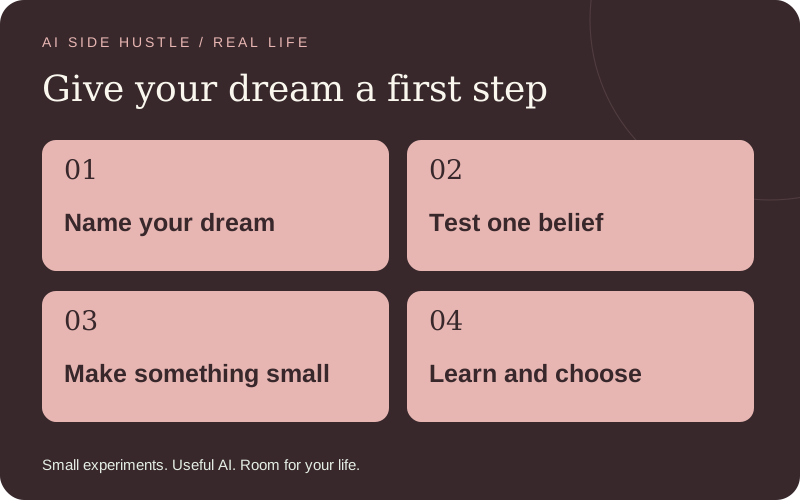
A dream becomes easier to act on when you can name the life change you want and the next thing you need to learn. More family time, creative independence, a career change, and extra household income may lead to different projects. Begin with the life you want the business to support.
Turn an ambition into a two-week experiment
- Describe an ordinary future day
Write what you want a normal Tuesday to feel like: work hours, flexibility, meaningful tasks, and time with people you love. Choose one constraint the project must respect.
- Write a testable belief
Replace “launch my dream business” with “three local trainers may need help turning workshop recordings into useful resources.” You are testing a problem, not your worth.
- Make the smallest convincing example
Create one sample, mockup, or demonstration. Use fictional inputs when needed. Ask a likely buyer to try it on a real task rather than only compliment its appearance.
- Review evidence and choose
At the end of two weeks, record conversations, objections, payment commitments, time, costs, and energy. Continue, narrow, or pause based on that evidence.
Three experiments you can run
| Experiment | Action | Decision rule you choose in advance |
|---|---|---|
| A service sample | Make one deliverable and discuss it with five relevant people. | Continue if at least one buyer wants to discuss a paid pilot and the delivery fits your time budget. |
| A digital resource | Test a small worksheet with three intended users on a real task. | Improve it if users finish the task but find a repeated obstacle; stop building more pages until the obstacle is resolved. |
| A small workshop | Share a precise topic, intended audience, outcome, and proposed time. Collect expressions of interest before booking costs. | Set your minimum viable attendance and payment requirements before committing to a venue or tools. |
These are suggested experiment thresholds, not scientific proof or predictions. Use a smaller test if your energy is limited. A result of “not this offer” can save months of work and still bring your larger dream closer.
Learn from leaders without comparing your beginning to their outcome
Sara Blakely’s account of starting Spanx describes noticing a specific clothing problem and pursuing a solution. Our practical takeaway: pay attention to small frustrations you understand and demonstrate the solution. Her success is an individual story, not a forecast for another founder.
Yvon Chouinard describes Patagonia’s origins in making climbing equipment and its later efforts to put company purpose into ownership decisions. Our practical takeaway: write down the values you want your project to protect, then make one operating decision that reflects them. You can choose a sustainable schedule or a capped community contribution long before running a large company.
Motivation that survives an ordinary week
- Choose a “minimum day” action that takes ten minutes, such as correcting one sample or asking one useful question.
- Keep a proof log: a problem understood, a sample improved, a promise kept. Record outcomes without turning every day into a productivity score.
- Share a weekly check-in with one supportive person. Ask for help with a concrete obstacle.
- Let the next action be small enough to restart after an interruption. Rest does not erase earlier progress.
Try this AI prompt
My dream is [life change]. My constraints are [time, money, family, energy]. Help me choose one two-week experiment. Give me a testable belief, one small sample, five interview questions, a spending ceiling, and keep/change/stop criteria. End with a ten-minute first step. Do not turn this into a full business plan.
Download the free experiment planner, or shape your offer. Browse the complete real-life guide collection.