Build an AI Work Crew for Your First Income Experiment
Evaluate the Grok bot experiment, choose a practical service, and configure ten original agent roles with a free playbook and templates.
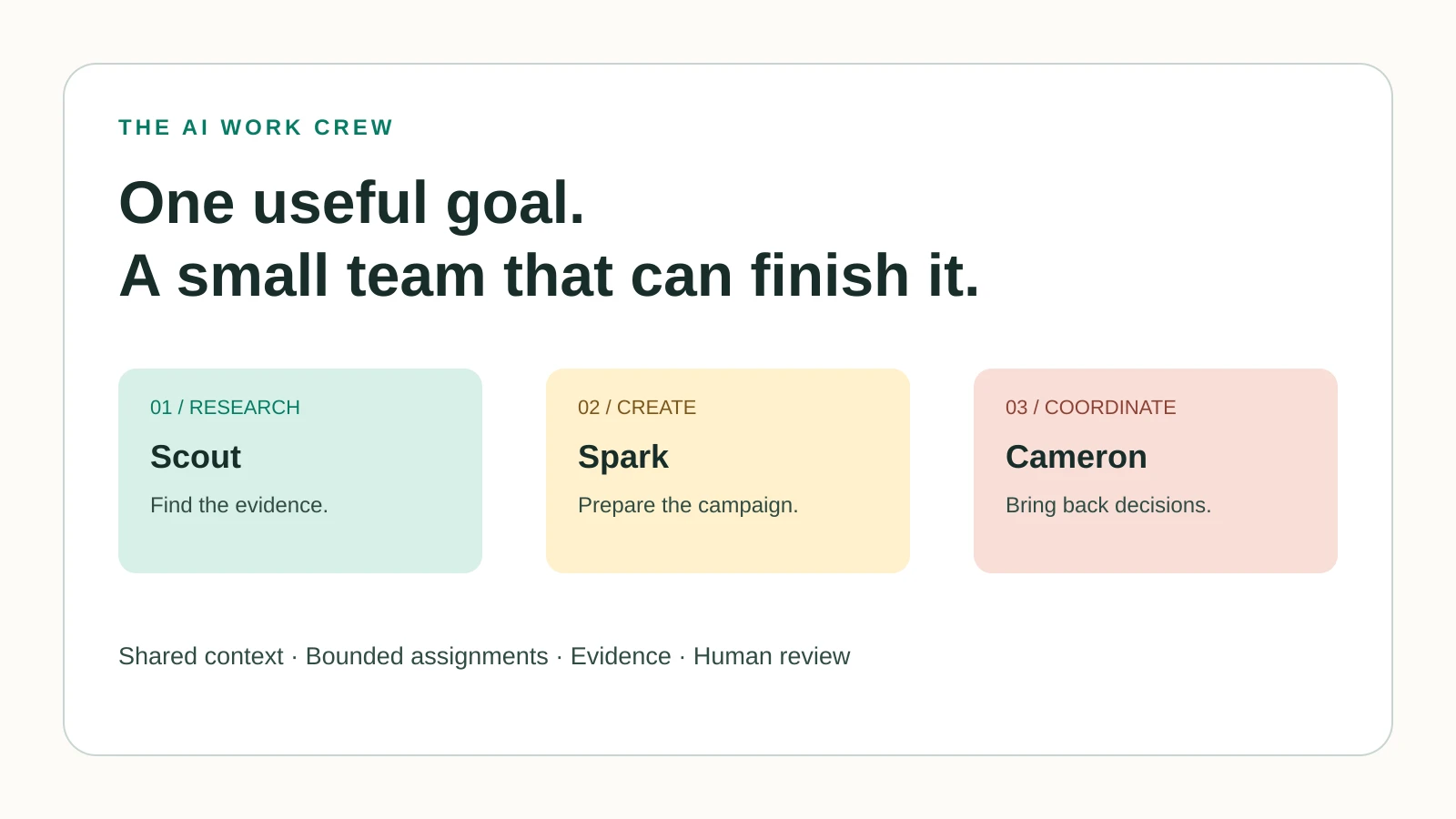
A bot that finds a promising lead has completed a useful task. Whether that task made money depends on what happened next: did someone buy, what did delivery cost, and how much human work was required?
That is the question we would put at the center of an AI side hustle. Give agents a small piece of a real business process, then judge the result with the same care you would apply to any other experiment.
Codie Sanchez's bot-building video and Contrarian Thinking's Build Your Grok Bots guide provide an interesting starting point. Our version changes the roles, adds explicit handoffs and test cases, and keeps earned revenue separate from estimated value. The downloadable playbook includes the detailed setup and a timestamped transcript assessment.
Read the animation steps
- You define the goal and limits.
- Cameron assigns a bounded task.
- Specialists return evidence and a draft.
- Cameron packages the proposed next action.
- You review and approve the defined action.
- Gauge records the result and feeds it back into the next brief.
What the video demonstrates, and what it does not
Our assessment is based on the video's timestamped transcript, rather than a visual audit of every screen action. The reported results are the creator's account; we have not independently audited transaction records.
Open the detailed reference table
| Workflow | What the experiment reports | How we would record it |
|---|---|---|
| Reselling free items | Roughly $88 from flips | Record sales, collection costs, delivery, fees, and review time before reporting profit. |
| Video clipping | No external client revenue in the trial, with internal editing savings discussed | Keep completed edits and demonstrated avoided expense separate from customer payments. |
| Cold outreach | The largest figure, roughly $2,000, assigns value to leads or calls | Treat as estimated pipeline value until a customer pays. |
| Day trading | A loss during the experiment | A reported loss, with no evidence of a dependable income stream. |
The useful lesson is that agents can participate in several kinds of work. The video does not establish that pasting a guide into a chat creates ten profitable businesses, or that the same results will repeat for another person.
Choose an offer before choosing a swarm
Start with a service you understand well enough to review. That might be turning an owned webinar into two checked clips, researching five suitable accounts for a client, or improving a small business's booking follow-up.
Write down who buys, what they receive, what is excluded, how long delivery takes, and how you will judge acceptance. A large bundle of vague services is hard for both a customer and an agent to understand.
For a first trial, choose one of these paths:
- A lead research brief. Deliver a small, sourced account list with fit evidence. Contactability and permission to send are separate questions.
- A campaign preparation pack. Turn an approved offer into a page outline, email drafts, and a measurement plan.
- A video repurposing pilot. Use a video you own or have permission to edit. Deliver two clips with checked captions and agreed formats.
Meet our AI Work Crew
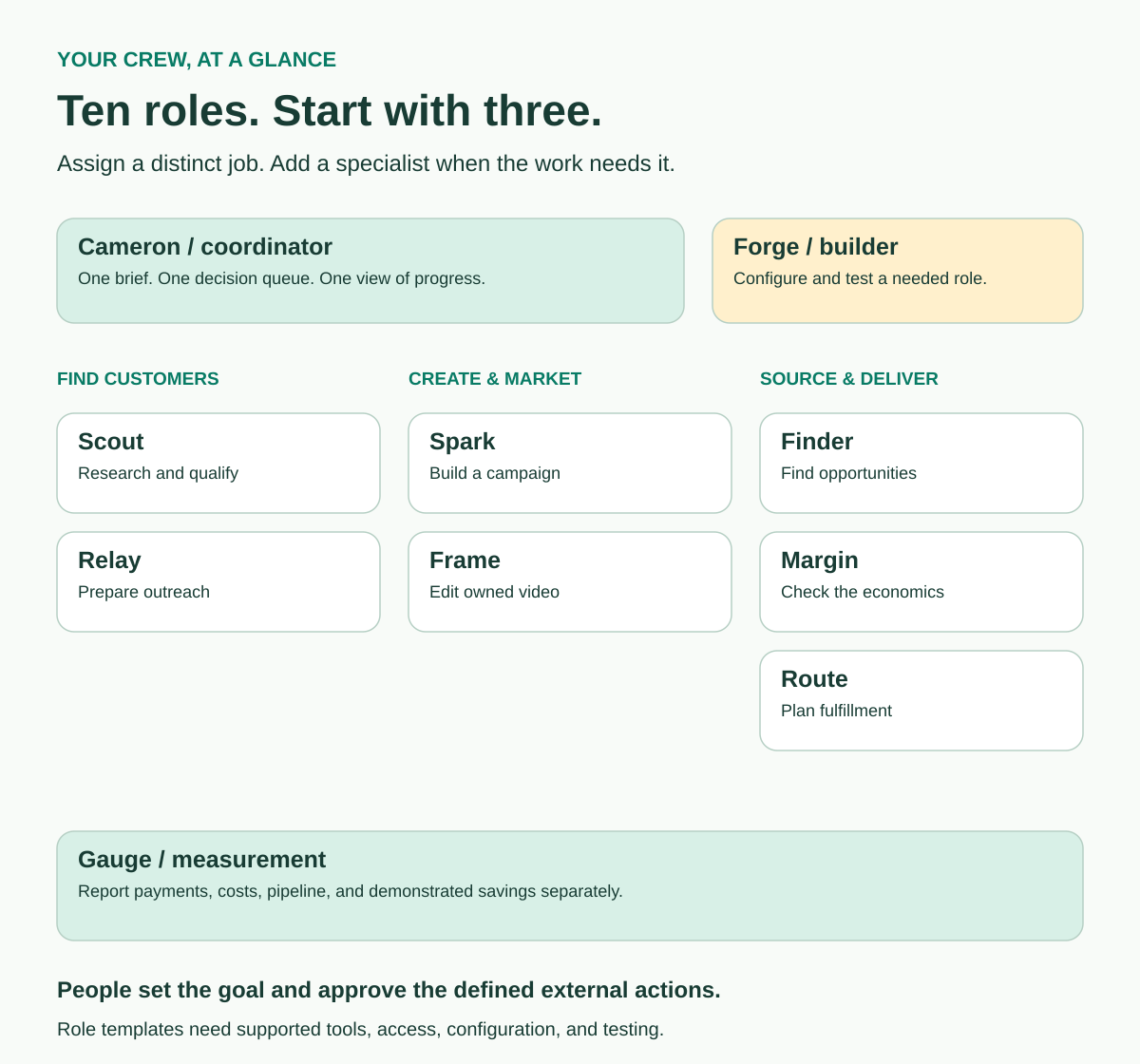
These are original role templates ready to configure and test. They are not ten live agents or guaranteed income streams.
Open the detailed reference table
| Role | Assignment | Evidence of useful work |
|---|---|---|
| Cameron | Coordinate the work | A short decision queue with links to outputs |
| Scout | Research prospects | Sourced accounts with a specific reason for fit |
| Relay | Prepare outreach | Accurate drafts and a contact log |
| Spark | Prepare campaigns | One connected campaign ready to review |
| Frame | Edit and repurpose video | Finished clips with verified captions |
| Finder | Locate sourcing opportunities | Current availability and item condition evidence |
| Margin | Check unit economics | Costs, assumptions, and a conservative margin range |
| Route | Plan delivery | A usable fulfillment plan and current quote |
| Gauge | Reconcile outcomes | Payments, costs, opportunities, and savings separated |
| Forge | Configure another role | A tested specialist or a clear report of missing setup |
Start with Cameron, Scout, and Spark. Add Relay when the contact process is ready. Use Frame for a video offer; Finder, Margin, and Route belong to a sourcing experiment. You do not need to activate all ten.
Can one agent create the others?
Sometimes. A role prompt, a temporary background worker, and a persistent bot are different things. The host platform must support the type of delegation you want.
Grok Bot documents a primary bot coordinating focused bots and bots creating other bots. OpenAI dots can delegate background tasks. Claude Code supports specialist subagents and nested delegation. Claude Duet supports background work, but its announcement does not establish the same user-controlled persistent bot factory.
Our platform comparison explains these differences. Pasting the templates does not automatically install tools, supply credentials, purchase subscriptions, or make a workflow run continuously. Ask the agent to inspect its actual capabilities and report the setup gaps.
Build the first lead research pilot
Step 1: Define a narrow buyer. For example, a local service business with a publicly observable booking issue. Do not infer revenue or personal circumstances from thin evidence.
Step 2: Give Scout a five-account limit. Require the source URL, checked date, observed issue, reason for fit, and unknowns. Check the list against existing customers, active opportunities, and suppression records.
Step 3: Have Relay prepare drafts. Personalization should describe an actual observation. An email lookup is not evidence that someone agreed to be contacted. Check applicable sending rules and provider requirements before a campaign.
Step 4: Review the complete sample. Correct weak matches before increasing volume. Approve recipients, final copy, sender identity, and the allowed follow-up scope together.
Step 5: Have Gauge follow the outcome. Record sent messages, replies, qualified opportunities, booked calls, paid orders, refunds, and costs as different events. A booked call can be valuable without being revenue.
Improve the free-item flipping process
The source playbook's $10 minimum-profit rule makes the idea easy to understand. We would improve it by defining what that $10 includes. A free sofa may require fuel, two people's time, storage, cleaning, and a second trip if a buyer does not arrive.
Use a conservative resale range. Subtract collection, preparation, delivery, fees, and an allowance for unsold inventory. Record your time separately. Verify condition and availability before making commitments. Let Finder identify candidates, Margin calculate the economics, and Route prepare logistics. A person still confirms the transaction and practical ability to fulfill it.
Improve the clipping process
Frame should return a short edit plan first: clip boundaries, the central point, caption treatment, and any missing rights or source files. Review that before rendering multiple videos.
Then inspect the actual exported file. Check names, captions, sound, framing, and whether the excerpt changes the speaker's meaning. A transcript and a set of timestamps are preparation; they are not finished video clips. Count revision time in the cost of delivery.
Run one seven-day experiment
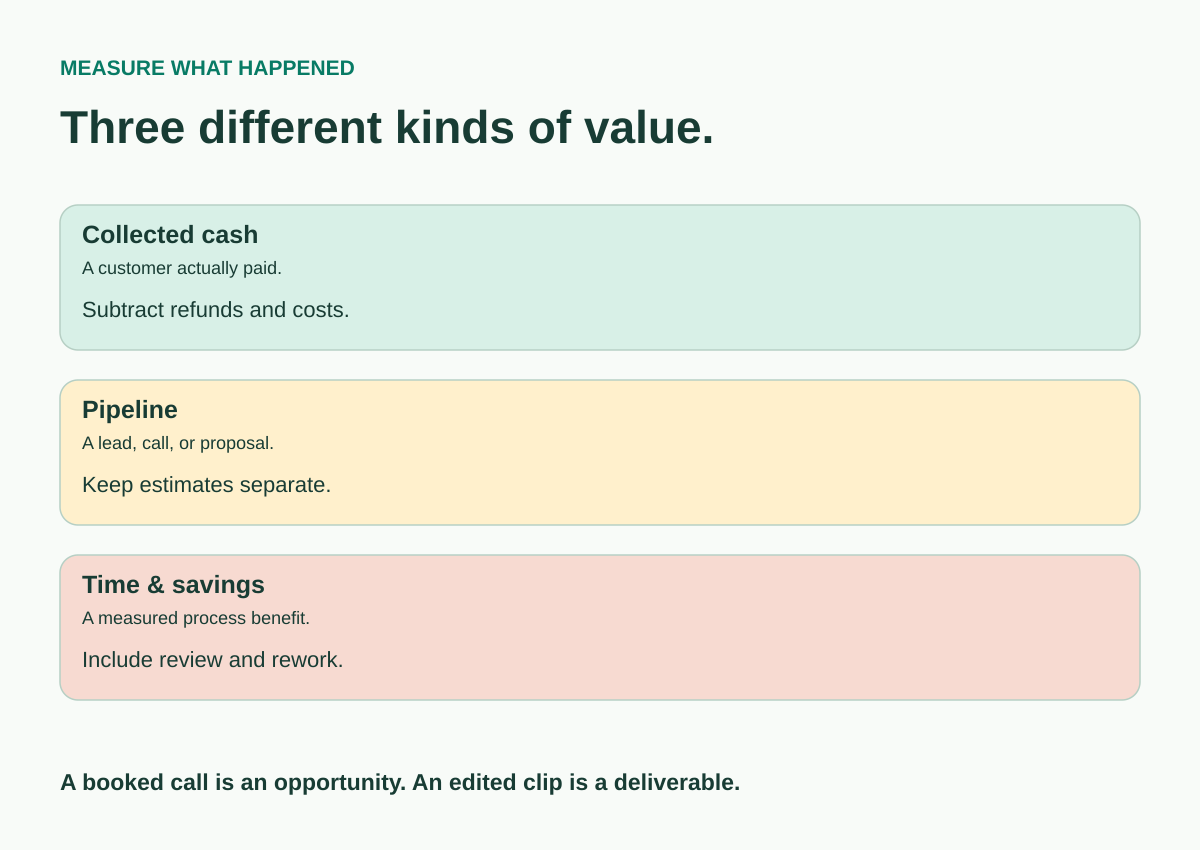
Use the first day to choose the offer, baseline, and time limit. Spend the next two days configuring and testing a small sample. Review it before any public action. Use the remaining days for the agreed pilot and an honest reconciliation.
At the end, ask: What did a customer actually receive? What cash arrived? What did it cost? What still needs human judgment? Would we repeat this at the same price?
Gauge includes an optional paper-only market research exercise. We would not make an autonomous trading bot the core of a first income experiment. Our beginner crew focuses on work you can inspect, deliver, and improve.
The aim is a repeatable service with a useful customer result. Let the agents help with the work, and let the evidence decide what deserves a second week.
Written by Ashley Kays. Platform documentation checked November 15, 2026. This guide draws inspiration from the supplied Contrarian Thinking playbook and video; the AI Work Crew names, prompts, handoffs, and tests are our own proposed system.