Turn one repeatable AI workflow into a service people can understand
Design a focused AI-assisted service with a clear deliverable, client inputs, quality checks, and a practical pilot before adding automation.
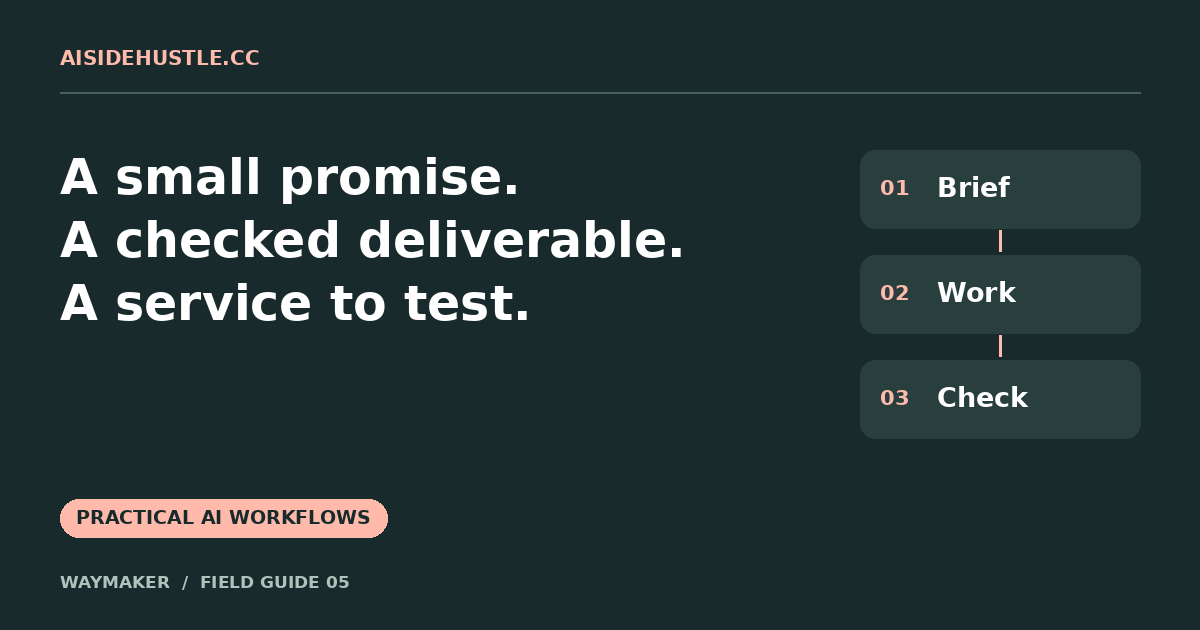
“I use AI” tells a potential customer very little. “I turn your approved webinar into an accurate follow-up package” is easier to understand. It names the input, the output, and a problem someone may already want solved.
A service built around AI still needs a customer, a defined scope, and a standard of quality. The useful starting point is a task you understand well enough to review. If you cannot recognize a bad result, faster production can make the service harder to deliver responsibly.
Choose a deliverable with an obvious finish
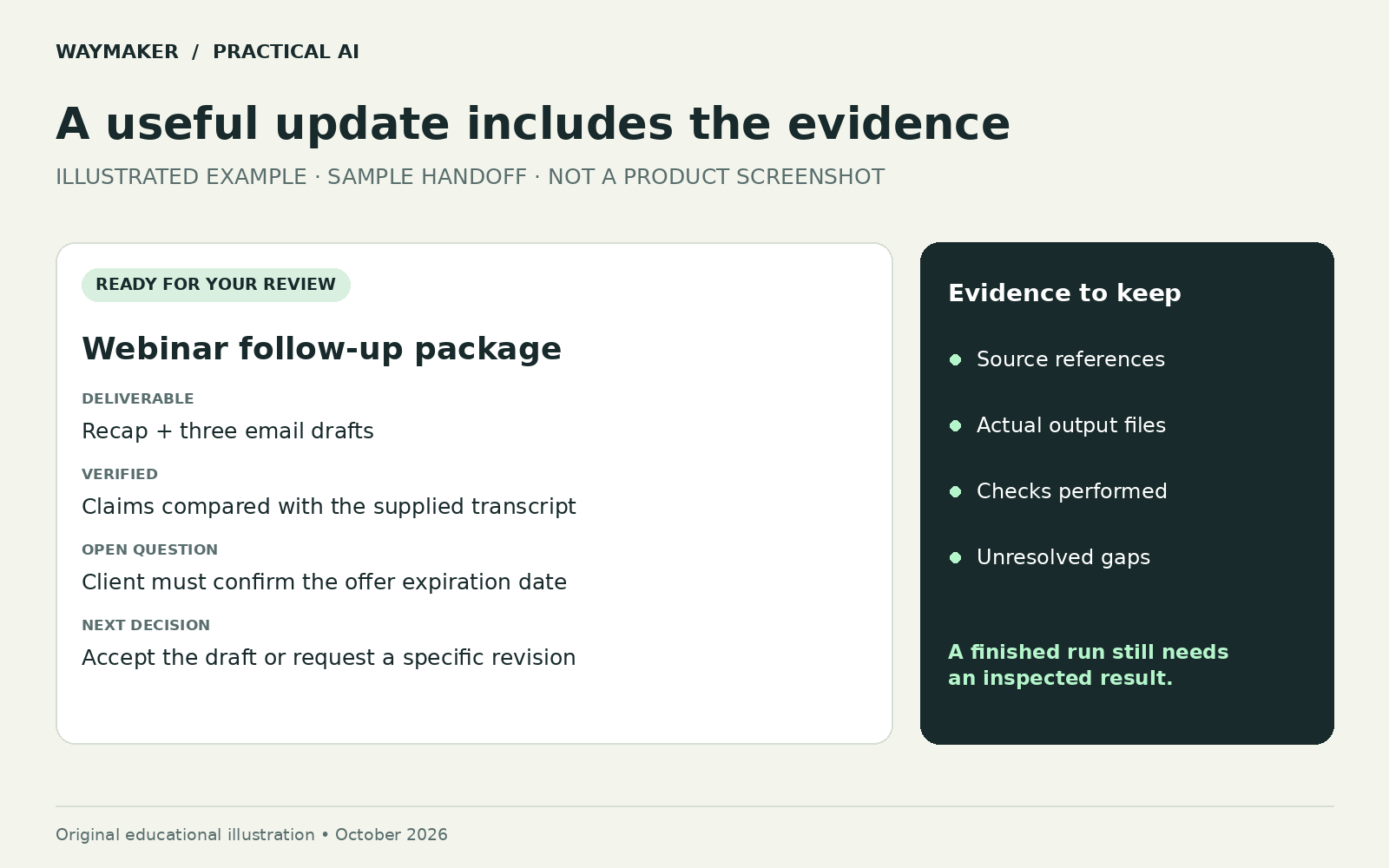
Imagine a webinar follow-up package for a small B2B team. The client supplies a recording or transcript they have permission to use, an approved offer, and audience notes. You deliver one recap, three email drafts, and a list of claims that need approval. The pilot covers one webinar and one revision round.
That scope is understandable. It also excludes a lot of hidden work: editing the recording, importing contacts, managing email infrastructure, and running the campaign. Those can become separate services later if customers want them and you can deliver them.
| Client supplies | You deliver | You verify |
|---|---|---|
| Approved transcript | Concise recap | Statements match the original |
| Audience and offer | Three distinct email drafts | Each email has a specific purpose |
| Brand examples | Tone and terminology alignment | Names, details, and claims are accurate |
| Revision feedback | One revised package | Requested changes are addressed |
Turn your expertise into the review standard
AI can help extract themes and draft copy. Your expertise determines whether the content is worth sending. Check that the follow-up delivers value, that the offer fits the audience, and that a speaker’s cautious statement has not become a confident promise.
For example, if a webinar says a tactic “may reduce setup time,” the recap should not claim it “cuts setup time in half.” Link each consequential claim to a timestamp or passage. When the source is unclear, ask the client instead of filling in the detail.
Using this approved webinar transcript and offer brief, prepare:
1. A 400-word recap.
2. Three email drafts with different purposes: recap, practical application,
   and invitation to the approved next step.
3. A claim-check table with transcript references.
Use only the supplied facts. Mark missing offer details for review.
Do not invent testimonials, statistics, deadlines, or speaker quotes.
Save all outputs as drafts. Do not import contacts or send messages.
Use the agent setup to support delivery
A proposed arrangement is Dot for the assignment checklist and follow-through, Work for preparing the package, and browser access for inspecting a draft in the client’s approved tool when needed. Keep one authoritative version of the deliverables so feedback does not split across several chats. The companion guide covers the product setup details.
The first pilot can be delivered as files. An automated email connection is unnecessary until campaign execution is part of an agreed scope. A small service should be able to create value before it requires a complicated stack.
Price from the work you can actually deliver
Estimate preparation, production, verification, revisions, and customer communication. Add applicable software costs and a buffer for the uncertainty of a first pilot. Then test whether a customer values the result at a price that makes delivery worthwhile.
Keep the first proposal concrete: what is included, what the customer supplies, when delivery starts, how revisions work, and what counts as acceptance. Do not guarantee revenue or campaign performance from a content package. Those outcomes depend on factors beyond the deliverable.
Build evidence before claiming expertise
Create a sample from your own material or a source you have permission to repurpose. Show the source-to-draft process and an example of a correction you made. This demonstrates judgment more credibly than a screenshot of a long list of agent names.
After a pilot, ask what was useful, what required rewriting, and whether the client would use the service again. Obtain permission before sharing their materials or feedback publicly. A sample can show how the process works; it should not be presented as a paid client success story if it was only a demonstration.
Automate the stable part
Once you understand the repeatable steps, save the brief and checklist. Automate only the portion with clear inputs and a result you can inspect. Keep an exception route for missing transcripts, changing offers, and factual uncertainty.
A viable side-hustle workflow makes a customer’s job easier at a cost both sides can support. Agents can help you produce the work. The offer becomes valuable when you can explain, deliver, and stand behind the result.
Explore more focused experiments at AI Side Hustle, or bring an idea to Two Mondays to a Side Hustle.
Companion guide: how Dot, Work, and browser access fit together.