A weekend AI side hustle experiment: make business content clearer
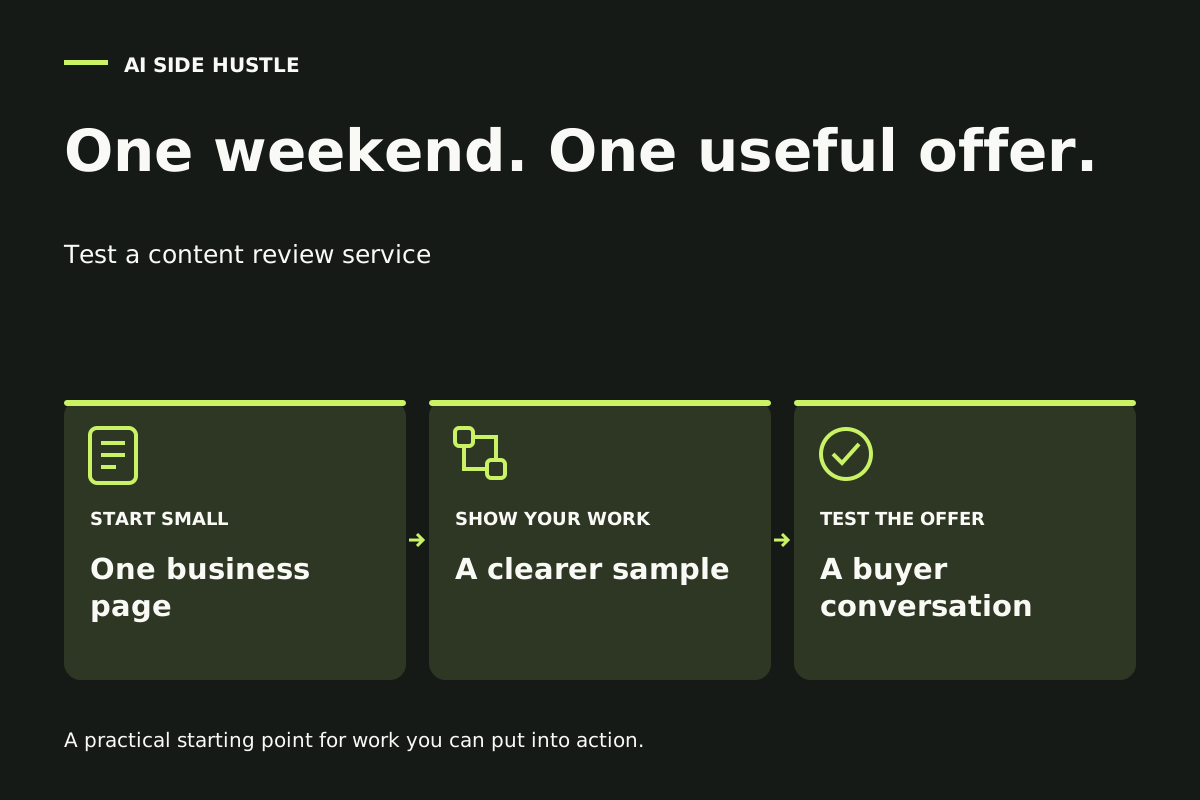
If you notice unclear instructions, inconsistent answers, and copy that says a lot without helping anyone, you have a useful starting point. Spend one weekend shaping a small content review service, producing a sample, and preparing your first buyer conversation.
Start with a problem you can recognize
Indeed’s 2024 article prompted this practical look at changing work.
A small business may have a service page that leaves customers confused, an FAQ with conflicting details, or AI-written posts that sound polished but miss the point. The useful work is deciding what the reader needs, checking the facts, and making the next action clear.
This is a good experiment for someone with writing, editing, customer-service, or industry experience. Choose a subject you understand well enough to review responsibly. Begin with ordinary business communication that you can check against owner-approved facts.
| Weekend output | What to include |
|---|---|
| Practice sample | One revised page, five FAQs, and a change summary |
| Quality check | Facts, consistency, reader questions, and next action |
| Offer draft | Deliverables, inputs, reviewer, revision limit, and timing |
| Learning note | Actual time, buyer feedback, and next experiment |
Friday: choose one buyer and one piece of content
Pick a business type you know: a local class provider, home-service company, independent consultant, or small online shop. Then choose one item, such as a service page or a set of five FAQ answers. A narrow starting point makes it easier to finish a sample and explain the offer.
Write a one-sentence promise about the deliverable: ‘I review one service page and five FAQs for clarity, consistency, and a clearer next step, then provide edited copy and a change summary.’ That describes work you can deliver without predicting sales or search rankings.
Set a weekend time budget. Two hours for the sample and one hour for the offer and conversation plan can be a useful starting limit. Adjust it to your own capacity; the purpose is to discover how the work fits your life.
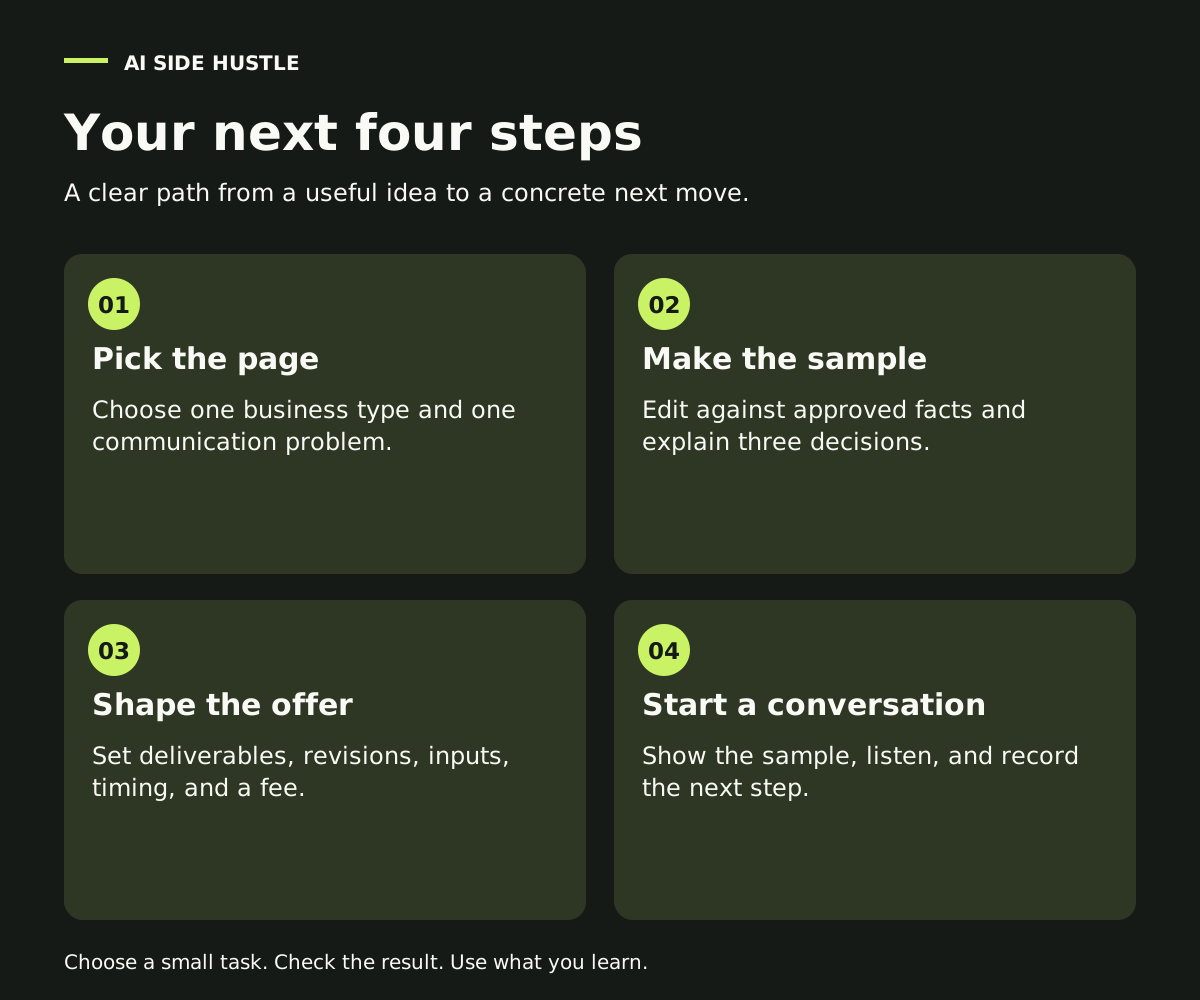
Your four-step starting plan
- Pick the page
Choose one business type and one communication problem.
- Make the sample
Edit against approved facts and explain three decisions.
- Shape the offer
Set deliverables, revisions, inputs, timing, and a fee.
- Start a conversation
Show the sample, listen, and record the next step.
Saturday: create the sample and show your judgment
Use a page you own, a practice brief you create, or material you have permission to edit. Gather a short fact sheet: what the service includes, who it is for, how booking works, and which details require confirmation. Write the original and revised versions side by side.
If you use AI, ask it to identify unclear passages and suggest alternatives using only the fact sheet. Review every suggestion. Keep useful edits, remove invented claims, and explain the three changes that matter most to the reader.
Your finished sample should include the revised copy, a short explanation of your decisions, and any questions the owner must answer. A simple document is enough. You do not need a full website or a large tool collection to find out whether you enjoy and can deliver this work.
Worked example: a clearer workshop page
Imagine a ceramics class page that says ‘everything included’ but never explains the session length, what participants make, or how to book. Your practice fact sheet provides those details. You reorganize the page around who the class suits, what happens in the session, what is included, and the booking link.
You also notice that the FAQ says finished pieces are ready immediately while the fact sheet says they need firing. You flag the conflict and use only the approved information in the revised version. Your change summary explains why the collection instructions belong near the booking decision.
That is the sample’s value: clearer information and visible reasoning. Describe it as a practice project if it is one. If a real business later uses your work, ask permission before sharing its materials or reporting its results.
Sunday: make the first conversation easy
Define what is included: one page up to an agreed length, five FAQs, a change summary, and one revision round. State what the owner provides and who approves the final text. Estimate the time for intake, checking, editing, communication, and revisions before setting a fee.
Prepare a short invitation you can personalize: ‘I’m testing a focused content review service for businesses like yours. It turns one service page and five FAQs into clearer, consistent copy. Could I show you a short sample and learn how you handle this today?’ Start with people or businesses you can approach appropriately; listen before pitching a larger project.
Decide what the weekend taught you
Record your total time, the parts you found difficult, and the questions a prospective buyer asks. Interest, a request for a proposal, and an agreed paid project are different stages. Use the evidence you actually have to choose the next step.
The World Economic Forum’s 2025 skills report highlights analytical thinking and creative thinking alongside technology skills. Our practical interpretation is simple: build the habit of spotting a real problem and explaining a useful decision. If this experiment fits, repeat it with a clearer scope. If it does not, keep what you learned and test a different service.
Sources and further reading
- Indeed: Future-Proofing Your Workforce (updated October 31, 2024)
- World Economic Forum: Future of Jobs Report 2025, Skills Outlook
Sources reviewed November 11, 2026. The practical examples and service ideas are editorial recommendations, not verified vacancies.