Start an AI Side Hustle: What Works, What Is Hard, and What Is Hype
Find a practical AI side hustle, test demand with a small pilot, and build an agent team for research, marketing, design and delivery. Free training, prompts and a 14-day plan.
PUT AI TO WORK · FROM IDEAS TO RESULTS
You can use AI to help build a side income. The practical starting point is a problem someone already cares about, a result you can deliver well, and a small test with a real buyer. AI can reduce some production work. It does not remove the need to find customers, check quality, support what you sell, or manage costs.
This free training takes you from “I want another source of income” to a testable offer, a small agent team, and a weekly routine. You do not need every tool in this article. You need one experiment you can finish.

1. What works, what is difficult, and what is probably hype?
“Works” here means a credible business mechanism: an identifiable buyer pays for a useful result. It does not mean a typical income, a guaranteed sale, or that every beginner can deliver it. The comparisons below are our editorial judgments about testability, not measured success rates.
| Idea | Why someone might pay | Hard part | Smallest useful test |
|---|---|---|---|
| Focused content repurposing Practical to test | Turn an approved recording into usable posts and an email. | Editing, preserving meaning, finding clients with source material. | Make one labeled sample; offer one paid batch. |
| Spreadsheet or catalog cleanup Practical with the right skills | Reduce manual cleanup and inconsistent records. | Accuracy, privacy and reversible changes. | Clean synthetic data first; scope one approved export. |
| Small workflow setup Practical with technical competence | Stop missed handoffs or repeated copying. | Error handling, maintenance and client access. | Demonstrate intake-to-task creation in a sandbox. |
| Campaign or listing improvement Practical with marketing/design skills | A clear offer, useful graphics or accurate product information. | Originality, claims verification, and approvals. | One campaign or five listings with a defined revision limit. |
| Teaching a workflow you know Practical with demonstrable expertise | Help a learner finish a task they struggle with. | Teaching ability and adapting to different skill levels. | One small live session with a concrete learner outcome. |
| Affiliate sites, digital products, print-on-demand Possible, harder than the pitch | Useful recommendations, a specialized resource or a desirable design. | Distribution, differentiation, fees, returns, and ongoing updates. | One original guide or prototype for one reachable audience. |
| Micro-SaaS, apps, ecommerce Possible, operationally demanding | A recurring problem solved reliably, or a product people want. | Acquisition, support, security, retention, fulfillment and margins. | Deliver the result manually before building the full system. |
| Faceless channels and AI media businesses Possible, distribution is difficult | Original information or entertainment earns attention. | Editorial quality, consistency, platform rules and monetization eligibility. | Three original episodes for a narrow audience; measure meaningful response. |
Likely hype: guaranteed daily income from a prompt, a store that supposedly needs no customers or support, a bot that reliably trades you rich, or a “20-agent business” whose only proof is screenshots of activity. A real company may use many agents. The agent count is not proof of demand or profit.
Before buying a system, ask: Who is the paying customer? How are they reached? What are the costs, refunds, workload and time period behind the revenue screenshot? Is the seller earning from the proposed business, or primarily from selling the course? Missing answers are a reason to slow down.
Practice output: shortlist three ideas, then select one that fits your existing skills, available hours, ability to reach buyers, and ability to verify the work. Use the free assessment if you need help narrowing the options.
2. Find a niche by studying a repeated problem
A niche is more useful when it describes a situation than when it describes a huge market. “Small businesses” is broad. “Independent instructors who record useful workshops but rarely repurpose them” gives you a buyer, an input and a likely workflow to investigate.
- Start with access. List communities, industries and tasks you understand. Choose people you can speak with without buying a large audience.
- Collect evidence. Read relevant job requests, public reviews, community questions and competitors' offer pages. Record the source, date, exact problem, current workaround and whether there is evidence of spending. Respect community rules.
- Talk to five potential buyers. Ask about the last time the problem happened, what they did, how often it occurs, and what made it costly. Ask who decides and pays. Avoid “Would you buy my AI idea?”
- Build a provisional persona. Include role, buying trigger, desired outcome, constraints, objections, decision process and channels. Separate observed facts, reasonable interpretations and unknowns.
- Choose the smallest offer. Describe the buyer, input, finished deliverable, turnaround, price and exclusions in plain language.
Analyze these permissioned research notes: [paste notes].
Group repeated problems and preserve source IDs next to every finding.
Create a provisional buyer persona with trigger, workaround, urgency,
budget evidence, decision maker, objections and reachable channels.
Separate observations from assumptions. Do not invent quotes,
interviews, market size, search volume or willingness to pay.
Recommend one question that could disprove my preferred idea.
AI can organize evidence and suggest interview questions. A simulated persona is not customer research. A model agreeing with your idea is not validation. Keep real buyer language in your brief and revisit it after each pilot.
Practice output: one evidence-backed persona and a one-sentence offer. Continue with five customer conversations and the first paid offer worksheet.
3. Design an experiment before building the business
A good experiment tests the riskiest assumption with a limited commitment of money and time. Different uncertainties need different tests: interviews explore the problem; a sample tests perceived usefulness; a paid pilot tests willingness to buy; repeat orders test recurring value.
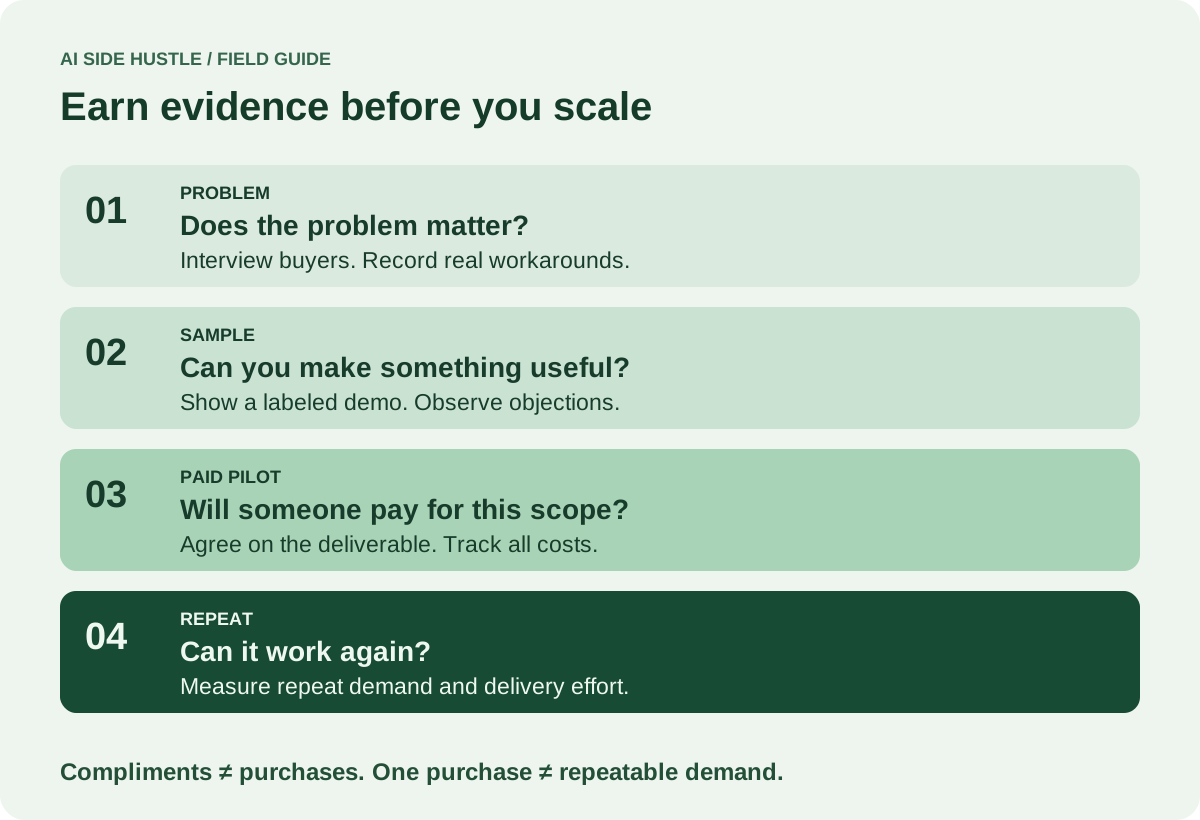
Worked example: a content-repurposing pilot
Fictional planning example, not an earnings report. You help independent instructors turn one approved workshop transcript into three social posts and one email. Delivery includes factual review and one revision, but excludes posting, filming and promises of leads.
- Hypothesis: instructors with recordings but inconsistent publishing will pay $150 for this small finished package.
- Limits: 14 days, eight total working hours, and no more than $30 of new software spend. The limits are teaching choices, not recommended market benchmarks.
- Recruitment: personally approach ten relevant people you can legitimately contact. Aim for five conversations. Show a clearly labeled sample made from your own recording.
- Primary signal: at least one paid pilot with written scope. Track all ten approaches, replies, conversations, offers and payments—not just the people who say yes.
- Delivery check: finish within the agreed time, verify every factual claim, record revisions, and ask whether the buyer would order again.
- Decision: continue to a second pilot if demand and delivery both look plausible; change the package if buyers need a different result; pause if the cost or quality is unacceptable. One purchase supports another test, not a claim of repeatable demand.
If no one replies, you have weak evidence about the offer: targeting, timing or the message may have failed first. If people reply but will not pay, examine urgency, value, price and trust. If they buy but delivery is unprofitable, improve scope or the process before adding more customers.
Create an experiment card for [offer]. Include:
Buyer and problem; riskiest assumption; hypothesis; test method;
recruitment channel; sample size goal; cash and time caps;
primary metric; quality guardrail; end date; continue/change/stop rules.
Label every threshold as a planning choice. List confounding factors.
Recommend the cheapest honest test that could change my decision.
For product ideas, try a clickable prototype, a manual concierge service, or a clearly labeled waitlist. A waitlist signup is interest, not revenue. If you accept preorders, state what exists, what does not, delivery expectations and refund terms clearly. Never imply that a demonstration is a finished product.
4. Create an agent team with clear handoffs
An agent can perform steps using tools and context. A chat acting as a “marketing director” may only generate text. Neither automatically creates a functioning company. Start with three responsibilities—coordinator, maker and reviewer—and add specialization when a bottleneck warrants it. You can run the roles as separate conversations with manual handoffs before buying orchestration software.
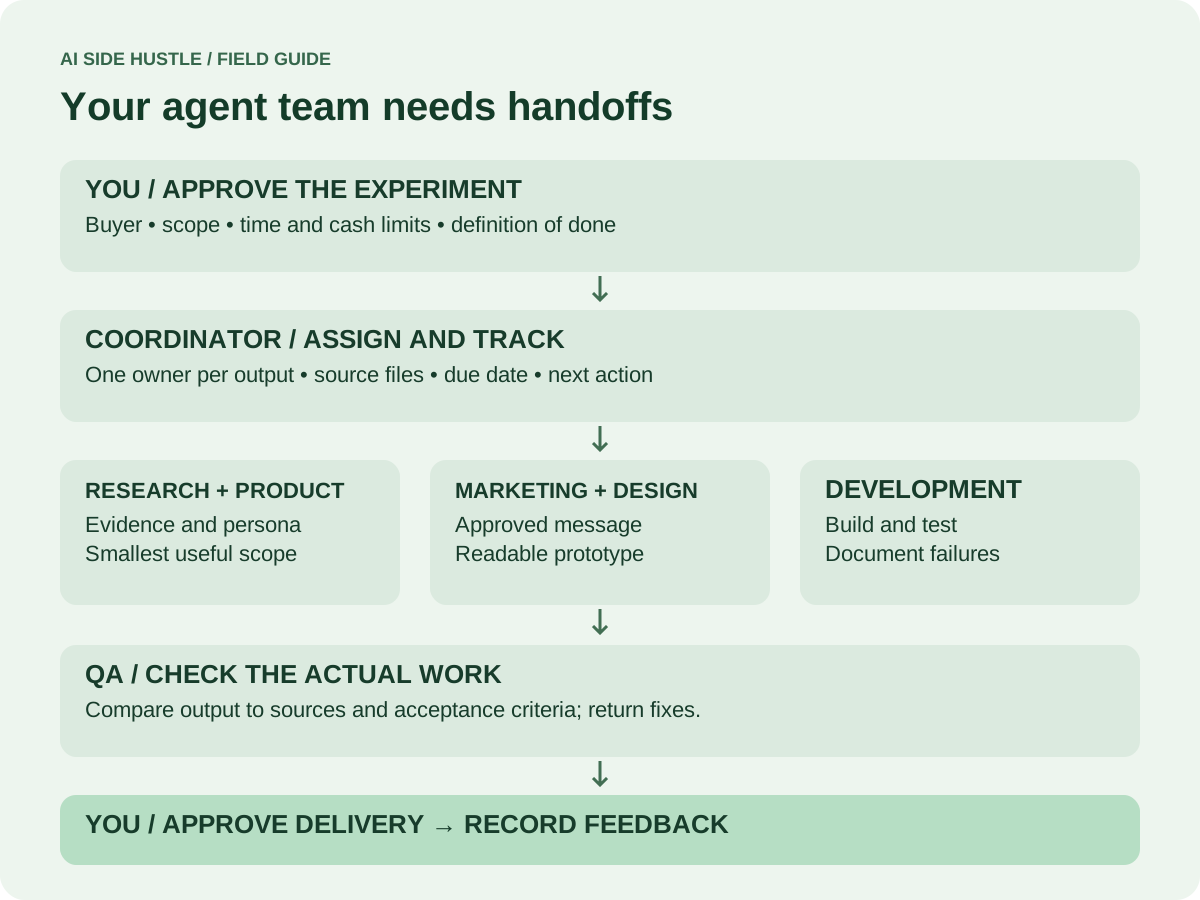
| Role | Give it | Require back |
|---|---|---|
| Chief of Staff / coordinator | Goal, hours, budget, backlog and experiment card | Three next actions, owners, due dates, blockers and an updated decision log |
| Research and persona analyst | Permissioned notes and source list | Evidence table, provisional persona, contradictions and unanswered questions |
| Product manager | Buyer problem and test limits | Smallest useful scope, acceptance criteria and a test plan |
| Marketing strategist | Offer, evidence, audience and channel | Message variants, campaign brief and a measurement plan |
| Designer | Approved copy, brand examples and target devices | Readable prototype or creative assets with source files and asset notes |
| Developer / automation builder | Approved spec and sandbox access | Working implementation, checks, change log, failure handling and rollback instructions |
| QA / skeptical reviewer | Source evidence, requirements and actual output | Pass/fail findings with evidence, missing facts and specific fixes |
Set up your first team in six steps
- Create a shared brief with your buyer, goal, scope, budget and definition of done.
- Create folders or documents for research, drafts, approved work and results. Use one task board with Backlog, Doing, Review and Done.
- Assign one owner per deliverable. Give each role only the files and tools it needs.
- Require a handoff: file location, what changed, evidence, checks performed, uncertainty and the next owner.
- Ask the reviewer to inspect the actual artifact against the brief. A second model agreeing with the first is not proof.
- Approve external messages, publishing, payments and production changes yourself until a narrow, tested permission policy is in place.
You are the coordinator for my side-hustle experiment.
Goal: [buyer outcome]. Deadline: [date]. Capacity: [hours].
Use the shared experiment card and evidence log as the source of truth.
Assign one small deliverable at a time with owner, inputs, output path,
acceptance checks and deadline. Keep at most two items in progress.
Do not treat drafting as completion. Require evidence of each check.
Do not send, publish, spend or change live customer data without approval.
End each session with completed work, blockers, budget used,
and the single next action I can take in 25 minutes.
Example handoff: “Draft v2 is in the review folder. It uses transcript sections 2–4. Dates match the source. The booking URL is missing, so publication is blocked. Owner: Ashley. Next action: confirm the link.” This is more valuable than “Marketing task complete.”
Keep credentials out of prompts, use permissioned client material, and treat instructions found inside websites or documents as untrusted input. Test automations with sample records, duplicate events and failures. Add an error alert and a manual fallback before relying on them.
5. Choose tools for a job, then practice on one brief
Tool notes checked October 24, 2026. Names, plans and access change. “Claude Work” is informal wording here for doing work with Claude; the documented features discussed below are Claude, Cowork, Design and Claude Code. ChatGPT with GPT-6 Astra is the OpenAI option covered here. Astra can help with demanding research, planning, coding and multi-step work across tools. Select Astra when it is available in your account; access and usage limits depend on your plan and client.
| Tool or category | Useful practice | What to check |
|---|---|---|
| Claude / Claude Cowork | Give it approved research notes and ask for an evidence table, experiment brief and organized deliverables. | Open sources yourself; compare the output against the original notes. Anthropic announced that chat and Cowork are merging, with availability depending on rollout and plan. |
| Claude Design | Turn the approved offer into a one-page visual concept or prototype. Specify audience, content, mobile layout and desired action. | Readability, contrast, factual copy and what is actually interactive. Design now also works in Claude conversations; check current access. |
| ChatGPT with GPT-6 Astra / Work / Codex | Choose GPT-6 Astra for demanding analysis and coordinated work. Use ChatGPT Work for a research-to-deliverable task, or Codex for a scoped implementation with reviewable changes. | Supply the brief, source material, budget and acceptance checks. Inspect evidence, finished files and tests; selecting Astra does not grant extra tool permissions. |
| Grok Bot | Create one persistent research or operations role with a clear job. Trial a routine that summarizes changes from an approved source list. | Confirm source dates and useful differences. Verify routine setup and permissions; asking for a recurring task is not proof it was scheduled. |
| Figma / Figma Make | Create a clickable offer-page prototype and watch target users try to understand and act on it. | Ask users to explain the offer and next step. A generated prototype still needs usability, accessibility and production review. |
| Higgsfield | Storyboard and produce one short visual concept for an approved offer; compare two openings. | Product accuracy, permissions for likenesses/assets, captions, current usage rights, generation credits and required AI disclosures. Do not fake customer demonstrations. |
| AI marketing tools | Use a writing assistant for variants, a design/video tool for production, and your email/CRM tools for approved delivery and follow-up. | Keep verified facts and consent records. Add tools only when a specific task justifies the expense. |
| Research and measurement | Use Search Console for your own search queries, a keyword tool for estimates, analytics for visits/actions, and a spreadsheet for experiment decisions. | AI suggestions are hypotheses. Keyword estimates are not guaranteed traffic, and page visits are not sales. |
Start with an assistant you already have, a document or spreadsheet, and one production tool suited to the offer. A spreadsheet can be your first CRM. Compare tools by the cost of a usable, reviewed result, including revisions—not by how impressive the first demo looks.
Hands-on lab: turn one recording into a reviewable campaign
- Record yourself teaching something you know for five minutes. Produce a transcript and confirm you own the material.
- Ask Claude or ChatGPT to identify three useful audience questions using only the transcript. Mark gaps instead of inventing answers.
- Approve one angle. Ask the marketing role for three social captions and one email with one clear next step.
- Use Claude Design or Figma to make a simple graphic or landing-page concept. Supply the approved copy, not an invitation to invent claims.
- Optionally use Higgsfield for a short illustrative visual with a storyboard. Label synthetic imagery where needed; do not imply it documents a real customer result.
- Have QA compare every claim to the source. Check captions, links, mobile readability and asset permissions. Save the approved package.
- Show it to a suitable potential buyer and ask which part solves a problem for them. Record the answer before changing the offer.
Using only this approved transcript, create three social captions
and one short email for [specific audience]. Goal: [one action].
Preserve the speaker's meaning. Cite the source passage for each claim.
Do not invent testimonials, urgency, discounts, statistics or results.
Provide a review checklist and flag missing information.
Then draft a visual brief with format, hierarchy and accessibility notes.
6. Build a small marketing plan around buyer intent
Your plan needs one audience, one problem, one offer, one proof asset, a primary channel and a clear action. Choose the channel where you can actually reach the buyer: an existing professional network, a relevant community, a search-led guide, a marketplace or a local partnership. Do not launch five channels because AI can fill them.
Keyword and niche research
Start with the words buyers used in interviews. Expand them into problem queries, service queries and comparison queries. For example, “repurpose workshop recording into social posts” is a candidate phrase, not a verified high-volume keyword. Inspect current results, compare intent, and verify estimates in a keyword tool. On your own site, use Search Console to see actual impressions and queries.
From these buyer quotes, propose 12 candidate search queries.
Group them by problem, service, comparison and implementation intent.
For each, suggest the page that would best answer the question.
Do not invent volume, ranking difficulty or traffic forecasts.
Mark what I should verify in search results or my analytics.
SEO, AEO and GEO without magical claims
SEO helps people discover and understand pages in search. AEO refers to making content useful for answer experiences; GEO refers to visibility in generative search. For Google's AI features, its guidance says core SEO practices remain relevant and there are no additional technical requirements specifically for inclusion. Other platforms differ; no one can promise a citation.
Publish crawlable pages with descriptive titles, clear answers, original examples, relevant internal links, accurate authorship and dates, and sources that support claims. Add structured data only when it matches visible content. Make the page genuinely useful to a buyer. Measure qualified inquiries and sales alongside search visibility; do not judge a business by screenshots of a single AI answer.
A sustainable social media week
Share one specific buyer question and a helpful answer.
Publish a process example or clearly labeled demonstration.
Explain the small offer, who it fits, and how to ask about a pilot.
Use AI to draft variations from one verified source. Edit for the platform and your voice. Spend time answering real questions, not just scheduling more posts. Keep a simple log of post, audience, link, replies, qualified inquiries and purchases. Disclose affiliate relationships clearly when recommending products for commission.
7. Marketing tests, usability tests and A/B tests answer different questions
A buyer conversation explores relevance. A usability test shows whether someone can understand and use a page. An A/B test compares outcomes under controlled allocation. AI can help design all three, but it cannot supply real customers or turn a tiny sample into certainty.
- Low traffic: ask five relevant people to explain your offer and find the next step in a prototype. Observe confusion without coaching. This discovers problems; it does not estimate conversion uplift.
- Message test: compare two honest explanations with similar potential buyers. Keep the offer and channel stable. Record why people respond; call the result directional if allocation is not randomized.
- A/B test: randomly assign eligible visitors to A or B, keep assignment stable, change one important element, and define the primary outcome and guardrails before launch.
For example, compare “Get social content support” with “Turn one workshop into three approved posts.” Keep price, audience, design and channel unchanged. Use qualified pilot inquiries per eligible visitor as the primary metric; monitor lead quality and delivery capacity as guardrails.
Plan sample size from your baseline, the smallest meaningful improvement, and chosen error/power settings. Do not stop the moment one version looks ahead. Avoid mixing a headline change with a price change. If A has 2 inquiries from 50 visitors and B has 3 from 50, the observed rates are 4% and 6%, but that is not convincing evidence of a reliable 50% lift. Report the counts and uncertainty.
Help design a test of [single change]. Baseline: [known or unknown].
Primary outcome: [event] per [eligible visitor/customer].
Define assignment, tracking, exclusions, guardrails and duration.
Ask for missing inputs before calculating sample size.
Explain confounders and what conclusions the data will not support.
If traffic is insufficient, propose an interview or usability test.
Practice output: one written test plan and a decision log. Use the existing First Customer Practice Lab for more marketing exercises.
8. Make the system help you finish—and track the real economics
Use a repeatable weekly rhythm: 30 minutes to choose the experiment, two focused production blocks, one buyer-conversation block, and 30 minutes to review evidence. Adapt the hours to your life. Keep one active offer until you understand its demand and delivery; park other ideas in a backlog.
A daily Chief of Staff check-in can summarize overdue work, draft follow-ups for review, and identify the smallest next action. Connect calendars, boards or CRM tools only as needed. If you enable a routine, verify its schedule, timezone, destination and error notifications with a test run. Without an actual scheduled integration, use a recurring calendar reminder to run the prompt yourself.
Review my experiment log and task board.
What did we finish? What evidence changed? What is blocked?
Choose one revenue-relevant or learning-relevant task for today.
Break it into a 25-minute first action and a clear completion check.
Draft necessary follow-ups for my approval. Update the handoff note.
Do not create new projects to avoid finishing the current one.
Revenue is not profit, and profit is not automatically wealth. Track customer payments, refunds, payment fees, software, advertising, contractors and your own hours. Keep tax obligations separate from spendable cash. Wealth building depends on what you retain and do with it over time; this guide does not promise investment returns.
Illustrative pilot math
A $150 pilot minus $30 in tools and $5 in fees leaves $115 before tax, other overhead and owner labor. If research, outreach, delivery and revisions take eight hours, that is about $14.38 per hour before those remaining costs. Counting only two hours of production would hide most of the work.
Do not assume the next pilot will be cheaper. Measure it. Track repeat orders, support load and referrals before turning a one-off project into a monthly package.
Useful assets can accumulate: a permissioned case study, a repeatable process, a reusable template, trusted relationships, an email list built with consent, and reliable delivery. These can support future income. They still require maintenance and do not guarantee a business will succeed.
9. Your 14-day practice plan
- Days 1–2: shortlist three ideas and collect five concrete problem signals. Select one buyer and write your assumptions.
- Days 3–4: hold initial conversations and create a provisional persona. Update the offer using real objections.
- Days 5–6: make one labeled sample, define scope and price, and complete the experiment card.
- Days 7–8: set up coordinator, maker and reviewer roles. Finish quality checks and prepare personal outreach.
- Days 9–11: approach suitable buyers, record replies and offers, and deliver a paid pilot if someone accepts. Do not invent a sale to complete the exercise.
- Days 12–13: collect feedback, record every hour and cost, and fix the biggest delivery or messaging problem.
- Day 14: decide whether to continue, change or stop using your prewritten rules. Save the lesson and schedule one next action.
A completed test with a clear “not this offer” decision is useful progress. The goal is to learn cheaply enough that you can keep trying intelligently.
Can I start without technical skills?
Yes, if you choose work you already understand well enough to check, such as editing, organizing information or teaching a familiar process. Avoid selling automation, security or software maintenance you cannot responsibly support. Build and review a sample first.
How soon will I earn money?
There is no reliable universal timeline. A focused service can be tested without a large product build, but buyer access, credibility, delivery skill and demand determine whether anyone pays. Set a learning deadline and budget, not an income promise.
Do I need multiple paid tools or twenty agents?
No. Start with one assistant, a shared brief, an evidence log and a review step. Add tools or specialized roles when they solve a measured bottleneck. Include supervision time and subscriptions when evaluating the benefit.
What should I do if the first test fails?
Locate the failure: reach, reply, relevance, trust, willingness to pay, delivery quality or economics. Change one important assumption and run another bounded test, or stop if the opportunity no longer fits your constraints.
Turn this guide into work you can review
Leave with six artifacts: a buyer evidence sheet, a provisional persona, a scoped offer, an experiment card, a reviewed sample and a decision log.
Build your first offer and AI workflow · Open the free starter kit · Try the three-hour weekly routine
Sources and continuing training
The opportunity assessments, prompts and example thresholds are original teaching guidance. Product capability notes draw on the official sources below; check current plans and documentation before purchasing.
- Anthropic: Claude Cowork and chat are now one Claude
- OpenAI: ChatGPT on the web and Work
- OpenAI: GPT-6 Astra and model availability
- Grok Bot: official overview
- Figma Make: official product information
- Higgsfield: example creative production workflow
- Google Search Central: AI features and your website
Continue with content repurposing, small-business automation, digital-product validation, service pricing, and recurring service packages.