Use AI to help a working product find its next customers
A focused experiment for founders whose product gets good feedback but has not yet built a dependable path to buyers.

Your product works. People who try it say they like it. Yet each new customer still feels like a separate project.
Before building another feature, investigate what happens between someone first hearing about the product and deciding to use it. Perhaps the right people rarely see it. Perhaps they do not recognize the problem it solves. Perhaps they understand the promise but cannot judge whether it will work for them.
AI can help organize that investigation and prepare the materials for an experiment. Your first job is to identify the question you are trying to answer.
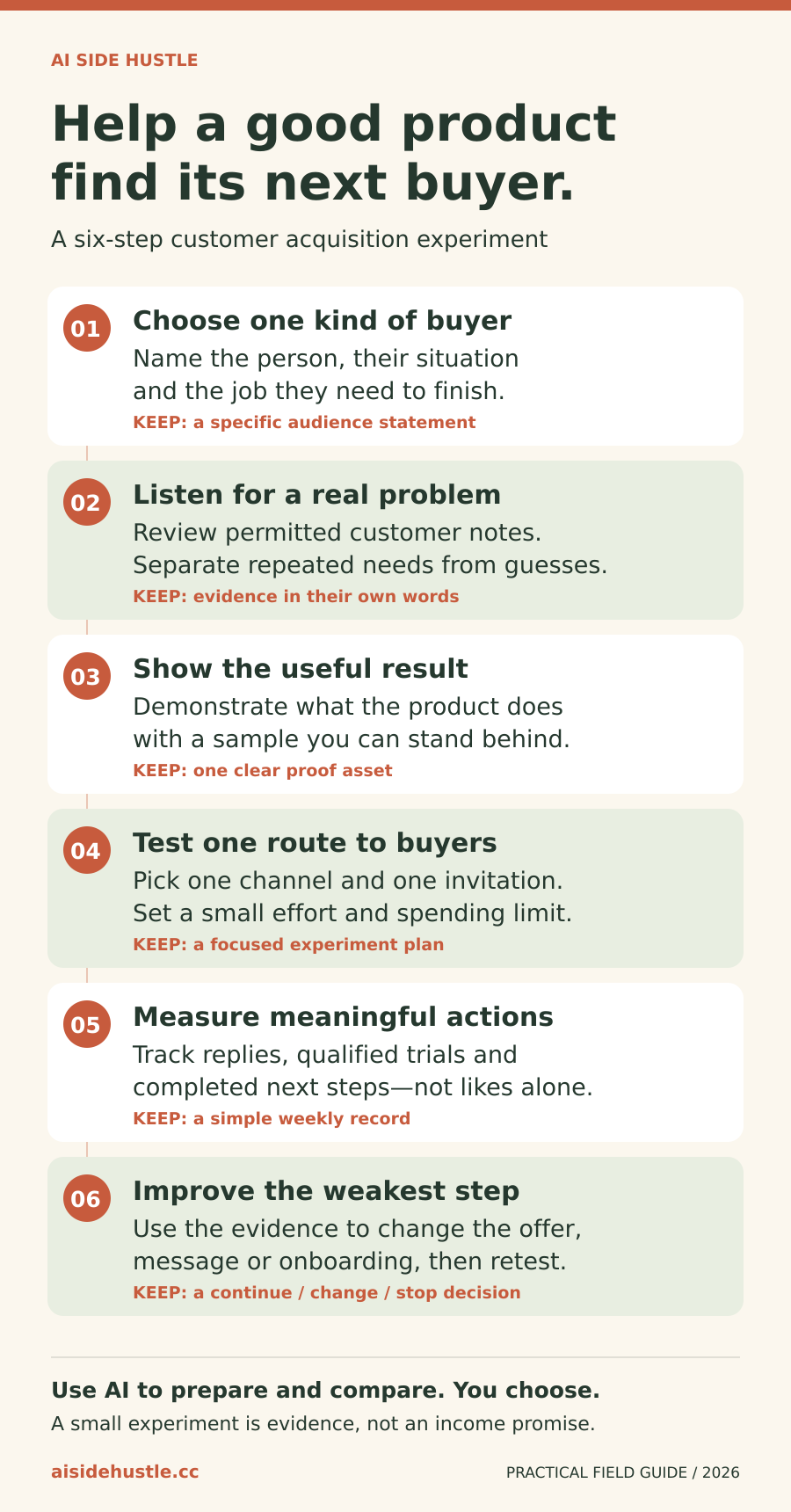
Find the weak point in the customer journey
Review what you actually know about recent prospects. Separate observations from interpretations. “Seven visitors opened the pricing page” is an observation. “The price is too high” is a hypothesis unless you have evidence explaining their decisions.
| Observed problem | Question to investigate | Possible experiment |
|---|---|---|
| Few relevant visitors | Where does this specific audience already look for help? | Test one useful post or partner placement aimed at that audience. |
| Visitors cannot explain the offer | Does the message name a recognizable problem and result? | Show a simpler page to several target users and ask what they expect. |
| Interested people hesitate | What evidence or detail would help them evaluate the fit? | Add a real walkthrough, sample, or clearly scoped pilot. |
| People start but do not finish setup | Which step prevents them from reaching useful output? | Observe that step and test a shorter path to first value. |
| People use it once | Does it solve a recurring problem for the intended customer? | Interview recent users about what happened after the first use. |
The table provides possible investigations. It does not diagnose your product from a few numbers. Ask customers about their actual behavior and review the relevant records before deciding which explanation fits.
Choose one customer and one moment
“Busy business owners” is difficult to design a useful experiment around. A narrower example would be independent workshop hosts who need to send useful follow-up material after an event.
Suppose your product turns workshop material into a draft learning kit. Your test message could explain that it helps a host prepare a recap, an exercise, and a next-step checklist from their existing material. The host still reviews the result before sending it to participants.
That specificity gives you something to demonstrate. It also makes it easier for a potential customer to decide whether the product belongs in their workflow.
Give AI a bounded research assignment
Review these approved customer notes and our current product page.
Identify three recurring problems mentioned by the customers.
For each problem, include the supporting passage and its source.
Separate customer statements from your interpretation.

For the best-supported problem, draft:
- One clear offer statement.
- A short demonstration outline using real product capabilities.
- Five questions for a customer interview.
- One landing-page headline and supporting paragraph.

List evidence we still need. Do not invent testimonials, user counts,
revenue, time savings, or demand. Save drafts for review.
Do not send messages, publish content, or purchase advertising.
Review the research before producing a month of content. If the proposed problem barely appears in the notes, generating more assets will not repair the evidence. You may need a different customer segment or more conversations.
Run a two-week experiment
Use the first few days to select the audience, confirm the problem, and prepare one believable demonstration. Create a short page that shows the input, the output, the limits of the product, and the next action a visitor can take.
For the remaining days, use one channel where you have a legitimate way to reach the audience: your opted-in email list, your own social audience, an approved community post, or an agreed partner introduction. If you test advertising, set and review the budget yourself.
Have AI help prepare variations and summarize results. Keep a simple record of what ran, who it was intended for, and the dates. Change one major element at a time where practical so you have a better chance of understanding the response.
Measure the next meaningful action
Pick a primary measure before the test. For a pilot service, it might be qualified conversations booked. For a self-serve tool, it might be people completing the first useful output. Record the denominator as well: three bookings from ten appropriate prospects means something different from three bookings from ten thousand broad impressions.
Use a small scorecard: relevant visits, primary actions, paid conversions if applicable, delivery effort, and the main reasons people did not proceed. Small samples provide direction and interview material; they do not prove that a message will work at scale.
Account for your time when considering the economics. In a hypothetical test, three sales at $200 create $600 in revenue. If delivery takes six hours valued at $50 per hour and tools and other variable costs total $100, the result is $200 after those listed costs, before tax and any uncounted overhead. Those assumptions matter more than the number of assets the assistant produced.
Use the evidence to choose the next move
If the right people engage but do not understand the offer, improve the explanation. If they understand but do not trust it, demonstrate the real output. If they buy but need substantial help, revisit onboarding, scope, or pricing. If the problem is not urgent enough, test a different problem before automating more promotion.
Your next useful AI system may be a weekly research-and-review routine: gather new evidence, update the experiment record, identify the strongest unanswered question, and prepare the next small test for your decision.