Build Side Income That Can Last: A 90-Day Path From Pilot to Repeat Value
Compare recurring services, digital products, small tools, and niche publishing, then measure what deserves more investment.
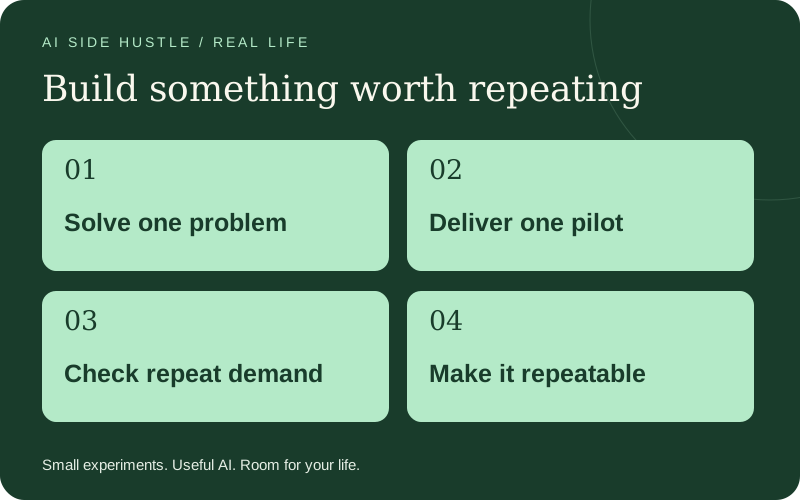
Long-term income usually comes from solving a problem repeatedly, retaining customers, or building an asset people continue to find useful. AI can help deliver and maintain that value. It does not remove the need for customers, quality control, distribution, or support.
Four models and their maintenance burden
| Model | Why someone buys again | Work that continues |
|---|---|---|
| Recurring service | The customer needs a new result each month: edited videos, an information update, or a report. | Source collection, review, revisions, scheduling, and customer communication. |
| Reusable digital product | A template or resource saves time on a specific task. | Testing, updates, customer questions, distribution, and compatible file formats. |
| Small paid tool | A narrow calculator or workflow solves a repeated problem. | Reliability, privacy, hosting costs, user support, and changes to dependencies. |
| Original niche publishing | Readers trust useful comparisons or firsthand demonstrations. | Research, real testing, disclosure, link maintenance, and an audience. Affiliate income is variable. |
A 90-day progression
- Days 1–14: learn one problem
Interview potential buyers and make a sample. Set a maximum time and cost for the test. Avoid building a subscription before anyone values the underlying result.
- Days 15–30: deliver a paid pilot
Agree the scope and payment terms. Log all delivery and revision time. Ask how the customer used the output and what remained unfinished.
- Days 31–60: check repeatability
Repeat the same scope with another buyer or another genuine cycle. Document inputs, checks, turnaround, and exceptions. Look for a recurring need, not only a one-off request.
- Days 61–90: package what works
Offer a clearly capped recurring scope or a small reusable product. Define support and cancellation terms. Automate only the parts that have become stable.
Measure the business you actually have
Track money collected, direct expenses, time spent, corrections, repeat customers, and delivery capacity. Gross sales alone hide whether the offer works for your life. A subscription is not durable merely because the billing repeats; customers must still want the result.
Hypothetical example: two monthly customers at $250 create $500 in collected revenue. If shared software costs $40 and direct delivery expenses total $60, $400 remains before taxes and other overhead. Ten hours of total work means $40 per hour at that stage. If revisions double the time, that falls to $20. Use your actual figures before expanding.
A decision at each review
- Keep: buyers use the result, delivery fits your capacity, and the economics meet your own minimum.
- Change: buyers value the result but the scope, price, or delivery process needs adjustment.
- Pause: nobody is willing to pay after a fair test, costs exceed your limit, or the workload harms responsibilities you need to protect.
Try this AI prompt
Review this side-hustle experiment using only my numbers: [revenue collected, costs, hours, repeat requests, problems]. Calculate the current pre-tax return per hour. Identify one scope change and one task that could become repeatable. Distinguish evidence from assumptions. Do not project guaranteed income.
Start with the existing monthly service package guide when a client has a genuine repeat need. If a product looks more suitable, use the digital-product test before building a catalog.
Download the free experiment planner, or shape your offer. Browse the complete real-life guide collection.